
There is a date in the diary. A wedding, a fortieth, a fortnight somewhere hot where everyone takes photographs of everyone else. And somewhere between the save the date and now, you have started wondering whether Morpheus8 belongs in the run up to it.
Fair question, and it has a proper answer, just not the one the adverts imply. What matters here is not what the device does. It is how long the whole process takes, first appointment to settled result, and that number is longer than most clinic pages let on. So treat this as a countdown, worked backwards from your date using published protocols, the manufacturer’s own manual and the one study that measured when anything appeared.
Short answer first
Months, not weeks. If your date is a few weeks out, that is a reason to wait for the next occasion rather than a reason to rush. If it is most of a year away, you have room to do this properly. Everything below is the working.
How long is a course, actually?
The most-cited Morpheus8 dataset, a 247-patient cohort treated for neck laxity and jowling, used 1 to 3 sessions spaced 3 to 6 weeks apart. The peer-reviewed acne and acne scarring work used 3 sessions in its radiofrequency microneedling arm. UK clinic pages commonly quote 3 to 6 sessions at 3 to 6 weeks apart, but that is clinic guidance rather than trial data, and it is worth knowing which of the two you are being sold when a package is on the table.
Take the common case of three sessions. Three sessions means two gaps. Two gaps of 3 to 6 weeks is 6 to 12 weeks between your first appointment and your last: six weeks at the quickest, three months at the more relaxed end. And that is only the treating phase, not the waiting.
One detail that rarely comes up: the manual sets a retreatment interval of every 3 to 4 weeks when energy is escalated in Fitzpatrick skin types V and VI. If that is your skin, the protocol sets your calendar, not your diary.
The downtime to plan for, not the one you were quoted
The 247-patient cohort records 2 to 5 days of downtime. That is the figure that ends up on clinic pages, and it is real in the sense that somebody published it.
Now open the manufacturer’s own operator manual. It describes erythema lasting not longer than 24 hours, oedema for 1 to 3 weeks, and crusting from the treated dots exfoliating naturally after 1 to 3 weeks. Minor pin-point bleeding may occur. Separately, an independent review of radiofrequency microneedling notes visible grid marks persisting 1 to 2 weeks.
Same treatment, two very different diary entries. One is a long weekend, the other is most of a month. Plan for the wider one: it comes from the company that makes the device, which has no reason to overstate it.
There is a tail on it, too. In the same cohort, swelling persisting beyond 6 weeks occurred in 4.8 percent of patients and hardened areas beyond 12 weeks in 3.2 percent. Roughly one in twenty was still swollen six weeks later. If your event sits six weeks after your last session, that is the risk, in the study’s own numbers.

When does anything actually show up?
Here the evidence thins out dramatically, and you should know how thin before you build a schedule on it.
One prospective study measured change over time. It followed people with premature jowl and neck laxity one to five years after a facelift, treated with Morpheus8 alongside a second radiofrequency device. Blinded investigators rated 33 percent markedly improved at 3 months, rising to 55 percent at 6 months. Patient-reported outcomes at 3 months were markedly improved in 67 percent, and no adverse events were recorded.
Now the caveats, and they are load bearing. Only 9 patients completed the protocol. Nine. That is not a sample anyone should hang a wedding on. Everyone in it had already had a facelift, so their skin was not starting where yours is. Two devices were used together, so no part of the change can be credited to Morpheus8 alone. And the senior author is the same clinician behind the flagship Morpheus8 datasets, which appeared in journal supplements sponsored by InMode and written by InMode consultants. That does not make the findings wrong. It does mean this is a shape, not a schedule.
The shape is the useful bit: whatever happens builds over months, and more people were rated improved at 6 months than at 3.
The part the adverts leave out
Here is the thing no advert mentions. Morpheus8 is not FDA approved. It is cleared, which sounds similar and is not. Clearance means the paperwork showed the device is similar enough to something already on the market. Nobody at the regulator signed off on it working.
The cleared wording covers electrocoagulation, haemostasis, and coagulation or contraction of soft tissue. No Morpheus8 clearance names wrinkles, skin tightening, acne scars, cellulite, stretch marks or fat reduction. Not one of them.
On 15 October 2025 the FDA published a safety communication about radiofrequency microneedling, reporting burns, scarring, fat loss, disfigurement, nerve damage and the need for surgical repair, and stating plainly that this is a medical procedure, not a cosmetic treatment. There is no sham-controlled randomised trial of Morpheus8 anywhere in the literature, and the one independent systematic review that excluded industry-funded studies rates the evidence base Level of Evidence 5.
Why that belongs in a countdown article: nobody has run the study that would tell you what your skin looks like by a given date compared with doing nothing. Any timeline, including this one, rests on protocols and small case series rather than proof.
Working backwards from the date
| Counting back from the event | What should be happening |
|---|---|
| 9 to 6 months | Consultation, then the first session. The comfortable end of the range |
| 6 to 3 months | The last of a three-session course lands here, since the course eats 6 to 12 weeks |
| 3 months | The earliest point the onset study rated anything, at 33 percent markedly improved |
| 1 month after each session | SPF 30 or higher, treated area protected from over-exposure to sunlight |
| 3 to 2 weeks | The outer edge of the manual’s oedema and crusting window, and of reported grid marks |
| Under 2 weeks | A reason to wait for the next occasion |
Add the two halves together and the arithmetic is not subtle. A three-session course takes 6 to 12 weeks. The only measured onset data runs from 3 months to 6 months. Stack them and you get roughly four and a half to nine months between your first appointment and any confidence about what you are looking at. That is arithmetic on published numbers, not a published timeline. It is still the most honest figure available.
The sun rule that ruins summer plans
The operator manual asks for SPF 30 or higher and protection of the treated area from over-exposure to sunlight for at least one month after treatment. It also prohibits excessive tanning of any kind for the entire treatment course. Not per session. The whole course.
Run that against a course spread over 6 to 12 weeks and the sun-avoidance window can stretch across most of a British summer. If the big event is the holiday itself, the conflict is direct, and the sun rules deserve their own read before you book anything.
A second schedule sits inside the aftercare. For Asian patients and Fitzpatrick types IV to V, the manual says a physician may prescribe a bleaching regimen for 6 to 12 weeks, applied 2 to 3 times weekly once healing is done (typically 7 days) and stopped 48 to 72 hours before the next session, to reduce the risk of post-inflammatory hyperpigmentation. Better to hear that now than a fortnight in.
Why a before and after cannot tell you the date
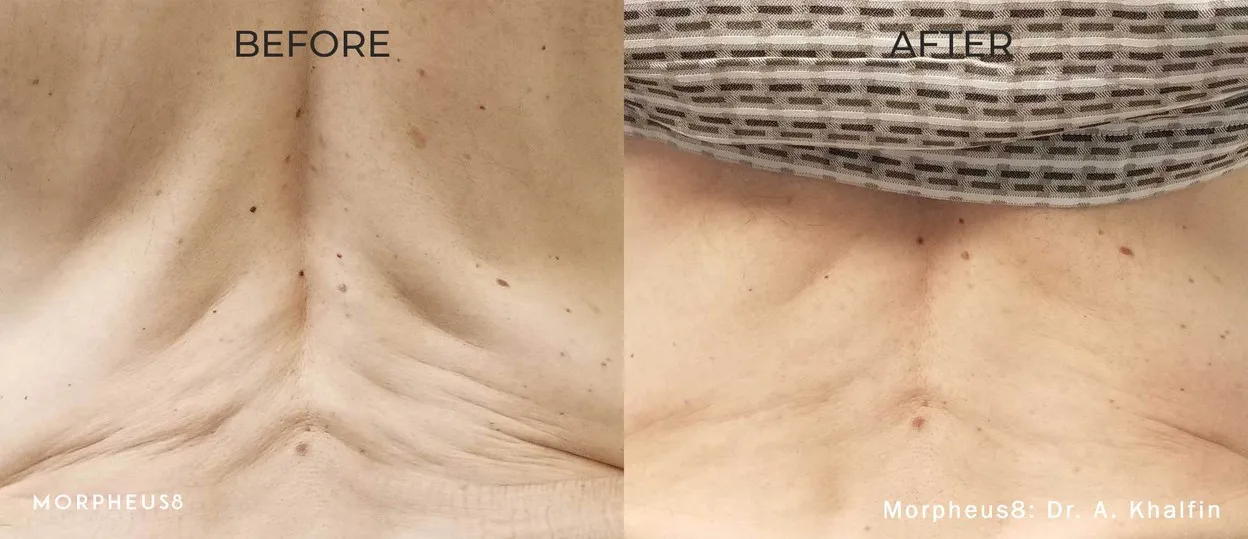
Photographs are why most people start counting, and they are the least useful planning tool you will meet. A pair tells you nothing about how long the gap between them was, how many sessions filled it, or what else was done at the same time.
The image below is a manufacturer image of somebody else’s patient, credited to the treating physician, not a patient of ours. Treat it as an illustration of what the device is marketed to address, nothing more. The same scepticism applies to the reviews you are reading while you decide: glowing accounts and difficult ones both exist for good reasons.
If the date is already close
Then the honest advice is to wait, and to be suspicious of anything that helps you not to.
Compressing a course means shorter gaps, or fewer sessions carrying more energy, or booking inside the window where the manufacturer says crusting and oedema are still resolving. None of that improves your odds on the day. It moves the risk closer.
Be wary of the pricing pressure too. Discounted packages appear exactly when people are counting down and feeling the deadline, and a price that looks too good is usually hiding something worth knowing about. A fixed date is the worst possible moment to decide quickly. The better version of this plan is dull: pick the occasion after the one you are worried about, start early, and let the calendar do the work rather than the energy dial.
If you want to know whether your timeline is realistic, book a consultation with us and bring the actual date. We will tell you what a course would look like against it, what the downtime range really is for the areas you are asking about, and, if the date is too close, we will say so.
At a glance
Booking a course against a fixed date, weighed honestly
+ Reasons in favour
- The treating phase is short enough to plan around. The most-cited dataset used 1 to 3 sessions spaced 3 to 6 weeks apart, so a course of three occupies roughly 6 to 12 weeks of calendar
- The interval is a range rather than a fixed date, so there is genuine room to place sessions around work, travel and other commitments instead of the other way round
- Nothing about the schedule is secret. Session count, spacing, downtime and aftercare all come from published protocols and the manufacturer's own operator manual, so you can check what a clinic tells you against them
− Reasons for caution
- No study tells you when a result will be visible for you specifically. The only prospective onset data comes from 9 people who completed a protocol, all of whom had also had a facelift and a second device used on them
- The downtime you plan for depends on which document you believe: 2 to 5 days in the published protocol, oedema and crusting over 1 to 3 weeks in the manufacturer's manual, and visible grid marks for 1 to 2 weeks in an independent review
- The aftercare outlasts the course. The manual asks for SPF 30 or higher and protection from over-exposure to sunlight for at least a month after each session, and no excessive tanning at all for the whole course, which rules some events out entirely
Frequently asked questions
The short version.
01How far ahead of a wedding should I book Morpheus8?
Think in months. A course of three sessions at the published spacing of 3 to 6 weeks apart takes 6 to 12 weeks on its own, and the only prospective study that measured onset rated patients at 3 months and again at 6 months, with more people rated improved at the later point. Stack those together and you are looking at somewhere between roughly four and a half and nine months from first appointment to a point where you would have any confidence about what you are seeing. That is arithmetic on published numbers rather than a published timeline. No study has ever tested a countdown to a fixed date.
02Can I have a session two weeks before the event?
Short answer: no, and the manufacturer's own paperwork is why. The operator manual describes oedema lasting 1 to 3 weeks and crusting from the treated dots exfoliating naturally after 1 to 3 weeks. An independent review records visible grid marks persisting 1 to 2 weeks. Booking inside that window means accepting a real chance that your skin is still visibly mid-process on the day.
03Will I definitely look better by the date?
Nobody can honestly tell you that. There is no sham-controlled randomised trial of Morpheus8, so no study has ever compared treated skin against untreated skin under blinded conditions, which is the comparison that would answer your question. The independent systematic review that excluded industry-funded studies rates the evidence base for radiofrequency microneedling Level of Evidence 5. Anyone guaranteeing you a result on a specific day is describing a hope, not a finding.
04How many sessions will I actually need?
The 247-patient cohort used 1 to 3 sessions. The acne and acne scarring work used 3. UK clinic pages commonly quote 3 to 6. The last of those is marketing guidance rather than trial data, so if you are quoted a six-session package for a fixed date, it is reasonable to ask which document that number came from and what changes between session three and session six.
05What if the event itself is a beach holiday?
Then the aftercare and the occasion are in direct conflict. The manufacturer's manual asks for SPF 30 or higher and protection of the treated area from over-exposure to sunlight for at least one month after treatment, and it prohibits excessive tanning of any kind for the entire treatment course, not just after each session. That is a rule that runs across the whole schedule, and it is the single most common reason a summer plan does not survive contact with the protocol.