
Somewhere between the comment sections and the consultation room, everyone asks the same two questions about Morpheus8. Am I too young for this? Or, from the other end, have I left it too late? Neither gets a straight answer very often, because the honest one is awkward for a treatment sold as suitable for anyone with skin. So here it is with the numbers attached: what age the published research covers, where it goes quiet, and what that means if you sit in the quiet part.
Short answer first
Twenty-two is the floor. After that, your age matters far less than what you are asking the treatment to do.
The published evidence clusters in two places and almost nowhere else: mid twenties for acne scarring, and mid fifties for laxity along the jaw and neck. If you are in your thirties or early forties hoping to get ahead of things before they start, there is no Morpheus8 study behind that plan. Not a weak one. None.
The only age number anyone official has published
The FDA states that it has authorised microneedling devices to improve the appearance of facial acne scars, facial wrinkles and abdominal scars in patients aged 22 and over. That is the closest thing to a written age rule in this field. It comes with a catch, and the catch is the interesting part.
Here is the thing no advert mentions: Morpheus8 is not FDA approved. It is cleared, which sounds similar and is not. Clearance means the paperwork showed the device was close enough to something already on the market to go on sale beside it. That is the whole test. Nobody at the regulator signed off on it working for any cosmetic purpose.
And no Morpheus8 clearance names wrinkles, skin tightening, acne scars, cellulite, stretch marks, body contouring or fat reduction. The cleared wording covers electrocoagulation, haemostasis, which means stopping bleeding, and coagulation or contraction of soft tissue. That is it.
So the FDA’s 22-and-over line describes devices holding those cosmetic indications. Some radiofrequency microneedling devices do: Vivace is cleared for facial wrinkles, Profound for facial wrinkles and the appearance of cellulite. Morpheus8 is not one of them, so the nearest thing to an age floor for this treatment comes from a category its own paperwork sits outside. Twenty-two is still the number we would work to. It is just worth knowing it is borrowed.

Where the research actually sits
| Your age | What the published Morpheus8 research covers |
|---|---|
| Under 22 | Nothing, and the FDA’s authorisation statement for microneedling devices starts at 22 |
| 22 to 30 | Acne scarring. One retrospective subgroup of 49 patients, mean age 25.4 |
| Thirties and forties | Inside the edges of the laxity cohort, which ran from 26 to 67, though the reported figures give a mean and a range, not a breakdown by decade |
| Fifties and early sixties | The largest dataset there is: 247 patients, mean age 55, treated for neck laxity and jowling |
| Over 67 | Past the top of the published range |
Two studies do most of the work in that table.
The young one is a 2025 retrospective covering 356 acne patients across three treatments. Inside it sits the older-scars subgroup: 49 patients, mean age 25.4, whose scarring scores fell from 178 to 132 on the ECCA scale, reported as a reduction of at least half, with satisfaction at 3.8 out of 5 and no adverse events recorded. The wider radiofrequency microneedling arm ran to 139 patients at three sessions each. Now read the funding line, because it is part of the finding: the authors are InMode consultants and the supplement was sponsored by InMode, although they state they bought their own devices.
The older one is the most-cited Morpheus8 dataset there is. 247 patients, 224 women and 23 men, mean age 55, range 26 to 67, treated for neck laxity and jowling. Their laxity scores improved by an average of 1.4 points from a starting 3.1, and 93 percent were recorded as pleased. It appeared in a supplement co-funded by InMode with all authors serving as InMode consultants, and it was reported twice, in 2019 and again in 2020, using the same 247 people. Published twice is not the same as replicated.
Then the asterisk that matters most here. Those patients were not having Morpheus8 on its own. It was combined with FaceTite or BodyTite, a bipolar radiofrequency procedure delivered under the skin, with 97.2 percent done under local anaesthetic and a mean procedure time of 58 minutes. Whatever those fifty-somethings got, they got from the combination, which does not transfer to a standalone session on a younger face.
So what about prejuvenation?
Prejuvenation is the idea that you treat before there is anything to treat, so ageing has less ground to make up later. As a concept it is not silly. As a Morpheus8 claim it is unsupported, which is worth knowing before you commit several hundred pounds to it in your twenties.
The young patients in the literature were there for acne scars, an existing problem with a visible target. Nobody has published a study of Morpheus8 used preventatively at any age. No dataset shows that a 29-year-old who starts now looks better at 40 than one who does not, because that study has not been done.
Meanwhile the risk side does not scale down to match your age. On 15 October 2025 the FDA published a safety communication on radiofrequency microneedling reporting burns, scarring, fat loss, disfigurement, nerve damage and the need for surgical repair, and stating plainly that this is a medical procedure, not a cosmetic treatment. Those outcomes are not the common ones, but they are documented, and a procedure carrying them needs an actual problem to justify it. Trading a real risk against a hypothetical benefit is a poor deal at any age.
Worth saying once, flatly: no sham-controlled randomised trial of Morpheus8 exists. The one independent systematic review that excluded industry-funded studies rates this entire evidence base Level of Evidence 5, the bottom of the scale.
Does starting earlier make it last longer?
No evidence either way, and the durability picture is thinner than almost anyone expects.
The longest peer-reviewed follow-up on record averages 2.1 years, from that same manufacturer-funded retrospective. Beyond it, no controlled durability study has been published, so a peer-reviewed figure for how long cosmetic results last does not exist. The durations in circulation, 1 to 3 years and 12 to 18 months, originate on clinic marketing pages rather than in trials, and should not be presented as evidence-based. Dermatologists quoted in the consumer press are more cautious again: the effects are not permanent, and annual maintenance is recommended.
Line that up against a start-at-30 plan and the arithmetic gets uncomfortable. You would be committing to maintenance at an unknown frequency, for an unmeasured duration, at full price each time, to prevent something nobody has shown it prevents.
Is there such a thing as too old?
Officially, no. There is no age wording in any Morpheus8 clearance and no published guidance sets a ceiling. The evidence simply stops: the laxity cohort tops out at 67.
The more useful question at the older end is not permission but scale. That cohort’s average improvement was 1.4 points from a starting score of 3.1, alongside a second radiofrequency procedure under local anaesthetic. It is a real, measurable shift, not a reversal, and anyone describing it as one is selling rather than informing.
If the eye area is your real reason for asking, that has its own narrow evidence, and we have set out what is and is not known under the eyes separately. The one safety review covering 364 periorbital zones reported no hyperpigmentation, hypopigmentation, scarring or prolonged erythema, which is reassuring about safety and says nothing about results.
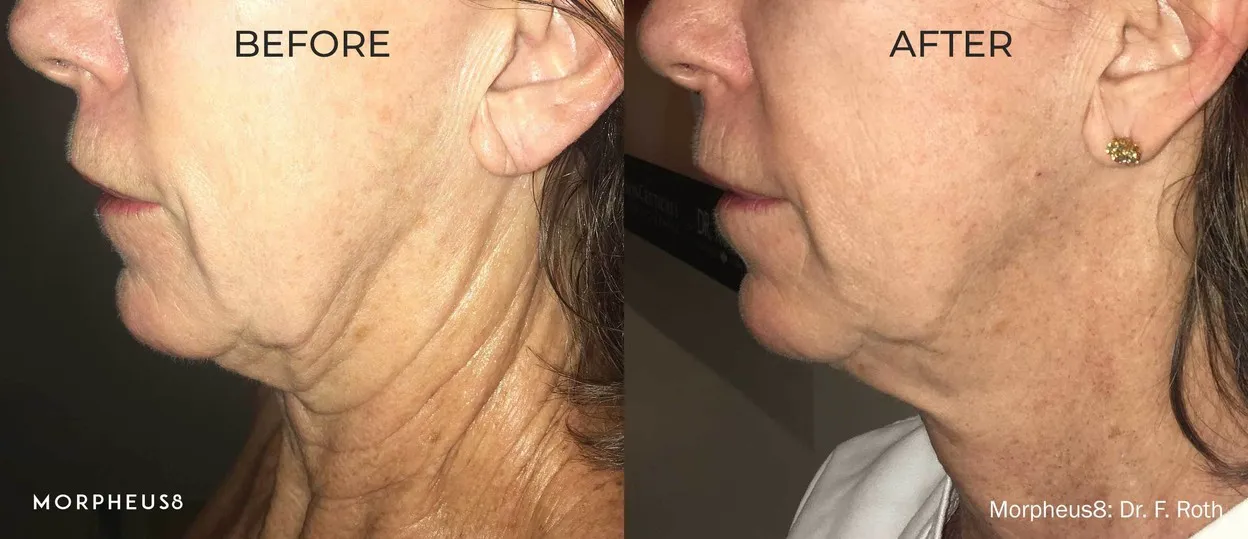
The pair above is the manufacturer’s own photography, treated by a physician elsewhere, not a patient of ours. It shows the best available case by definition, which is why the age of the person in it matters as much as the lighting. If you are using pictures to decide, learn how to read a before and after sceptically first.
What actually decides this, and it is not your birthday
Three things outrank your age, every time.
What you are treating. Old acne scarring and neck laxity are the two things with published Morpheus8 data attached, and they are where the age question answers itself: one skews young, one skews older, and both have a visible target.
Your skin type. Treatment parameters in the published acne work are stratified by Fitzpatrick type, with settings for types V and VI reduced by roughly 20 percent. Skin tone shapes depth and energy far more than the birthdays behind you.
Your health, your medication and your history, which is long, specific and genuinely disqualifying in places. We set out who this treatment is not for in full.
And if you are under 18, our answer is no. There is no statutory rule to cite in England, because no licensing scheme for non-surgical cosmetic procedures is in force yet, but that absence is not permission. If the concern is active acne rather than old scarring, that is a diagnosis question: see a GP or a dermatologist first, and treat the acne before anyone discusses its aftermath.
Where that leaves you
Twenties with acne scarring, or fifties with laxity, and you are asking something the research has at least looked at, modestly, with a sponsor’s name attached in both cases. Anywhere in between with prevention as the goal, and you would be paying for an idea rather than a finding.
None of which means the answer is no. It means it depends on the target, not the birthday. Book a consultation with us and we will tell you which of those descriptions you fit, what the realistic ceiling is, and, quite often, that the sensible move is to wait or do something else entirely.
At a glance
The age question, weighed honestly
+ Reasons in favour
- There is at least one number in writing. The FDA states it has authorised microneedling devices for patients aged 22 and over, which is more than most aesthetic treatments can point to
- The published laxity cohort spans a genuinely wide age range, 26 to 67, so nobody inside that band is being treated completely off the map
- Acne scarring has its own dataset with a young average, mean age 25.4, so a twenty-something asking about scars is asking something the research has at least looked at
− Reasons for caution
- The strongest laxity dataset has a mean age of 55 and those patients were also having FaceTite or BodyTite at the same time, so it cannot tell you what Morpheus8 alone does to a face in its thirties or forties
- Prevention, or prejuvenation, has no Morpheus8 dataset at any age. Starting early to stay ahead of ageing is a marketing idea rather than a finding
- No controlled durability study exists, so whatever age you start at, the size of the maintenance commitment you are signing up to has never been measured
Frequently asked questions
The short version.
01Am I too young for Morpheus8 at 25?
Not automatically, but it depends what you want it for. If the answer is acne scarring, 25 sits right on top of the one dataset that covers young patients: a subgroup of 49 people with older acne scars, mean age 25.4. If the answer is that you want to get ahead of lines you have not got yet, there is no study supporting that at any age, and a treatment with burns, scarring and fat loss on its reported adverse event list needs a real target to be worth it.
02Is there an upper age limit for Morpheus8?
Nothing official. No Morpheus8 clearance contains any age wording at all, and no published guidance sets a ceiling. What does exist is the edge of the evidence: the largest laxity cohort ran from 26 to 67 years old, so past 67 you are outside what has been reported rather than outside what is allowed. Expectations matter more than the number. That cohort improved by an average of 1.4 points on a laxity score from a starting 3.1, alongside a second radiofrequency procedure, which is a real shift and not a reversal.
03Can under-18s have Morpheus8?
Our answer is no. There is no statutory age rule to point at in England, because no licensing scheme for non-surgical cosmetic procedures is actually in force yet, though the Government's consultation response proposes prohibiting under-18s unless a GMC-registered doctor approves it. Proposals are not law. The nearest published number is the FDA's, which is 22 and over. If the reason for asking is active acne rather than old scarring, that needs a diagnosis first, from a GP or a dermatologist, not a device.
04Does starting younger make the results last longer?
Nobody knows, and that is not a dodge. No controlled durability study of Morpheus8 for cosmetic skin tightening has been published, so there is no peer-reviewed figure for how long results last at any age, let alone a comparison between starting at 30 and starting at 50. The longest follow-up on record averages 2.1 years and comes from a manufacturer-funded retrospective. The 1 to 3 years and 12 to 18 months figures you see quoted trace back to clinic marketing pages, not to trials.
05I am 45. Which study applies to me?
Partly the laxity one, at a stretch. Its range spans 26 to 67, so 45 sits well inside it, but the reported figures give a mean and a range rather than a breakdown by decade, so how many patients were your age and how they did is not something anyone can tell you. Mid forties is the honest grey zone of this treatment: old enough that laxity is a real target, young enough that you are extrapolating from a cohort whose average was 55.