Short answer: no. Longer answer: the question is fair, and the reason people keep asking it is more interesting than the answer.
If you have spent an evening searching Morpheus8 prices, you will have noticed something odd. Nearly every figure you can find belongs to a clinic in London. Knightsbridge. Shoreditch. Cavendish Square. Harley Street. Scroll for long enough and it starts to feel as though the treatment properly lives inside the M25. That impression is created by which clinics choose to publish their prices, and it tells you far less than it appears to.
Every published price we hold is a London price
The awkward part first, before any numbers.
The pricing evidence behind this article is nine UK clinic price lists captured during research in 2026. Eight name a London location. The ninth lists itself simply as UK-wide, with no city attached. There is not a single Midlands figure in the set: no Birmingham price, no West Midlands average, nothing.
So every pound sign further down this page describes what London charges. It is not a Birmingham price and it is not a regional average, and we are not going to turn one into the other by dividing by a rent index and calling it research.
Which leaves one reliable way to find out what a course costs where you live: ask two or three local clinics for a written quote: how many sessions, which areas, and who performs them. An article that claims to know has made the numbers up.
The skew is worth noticing on its own terms. A published price list is a marketing document, and the clinics that publish one are not a random sample of the clinics that exist. Where a clinic sits on a map tells you about its rent, not about who is holding the handpiece inside it.
What London charges, since we have it
Treat this as a picture of one city, not a national benchmark.
| Treatment area | Single session | Course of 3 |
|---|---|---|
| Eye area | £399 to £625 | £945 to £1,450 |
| Full face | £500 to £1,580 | £1,650 to £2,200 |
| Face and neck | £620 to £1,250 | £1,750 to £3,000 |
| Neck or chin alone | £200 to £400 | £560 to £1,120 |
| Body, abdomen and similar | £300 to £1,800 | £840 to £3,240 |
Two things before you use those figures. Package prices are almost always for three sessions unless the clinic says otherwise, and at least one clinic on the list quotes a body package at £3,835 for six sessions, which is not comparable to anything in the right-hand column. And one London provider describes the market as running from roughly £400 at budget clinics to £900 to £2,200 at premium London clinics: a wide enough band to treat as a shape rather than a rule.
If a price anywhere lands dramatically below all of that, the useful reaction is not relief. It is to work out what has been taken out to get there.
The machine does not know where it is
There is one Morpheus8. It is made by InMode, and it does not ship a metropolitan variant.
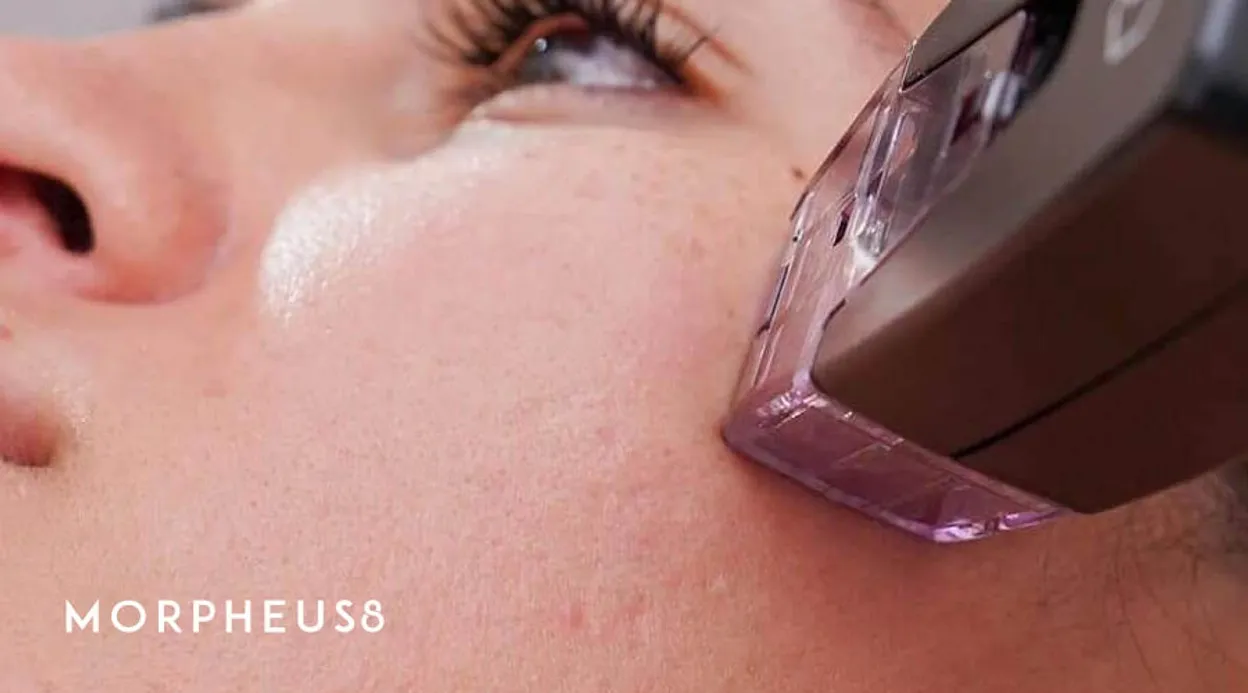
The specification is the same in every treatment room in the country: gold-coated needle electrodes, insulated except for the exposed final 0.5 mm, delivering bipolar radiofrequency at 1 MHz with a maximum output of 65 W, applied fractionally to less than 5 percent of the coverage area. The standard 24-pin tip runs 1 to 7 mm and the 40-pin body tip 2 to 7 mm, with roughly a further millimetre of thermal effect beyond wherever the needle stops. The FDA clearance summary states a maximum treatment depth of 4.0 mm.
The regulatory position is just as portable, and here is the part no advert mentions. Morpheus8 is not FDA approved. It is 510(k) cleared, which sounds like the same thing and is not: clearance means the paperwork showed the device was similar enough to something already on the market. Nobody signed off on it working. No Morpheus8 clearance names wrinkles, skin tightening, acne scars, cellulite, stretch marks, body contouring or fat reduction. The cleared wording covers electrocoagulation, haemostasis, and coagulation or contraction of soft tissue.
On 15 October 2025 the FDA published a safety communication on radiofrequency microneedling, reporting burns, scarring, fat loss, disfigurement, nerve damage and the need for surgical repair, and stating flatly that this is a medical procedure, not a cosmetic treatment. No sham-controlled randomised trial of Morpheus8 has been published, and the one systematic review that deliberately excluded industry-funded studies rates the whole evidence base Level of Evidence 5.
None of that improves with a W1 postcode. A prestigious address does not upgrade a clearance, and it cannot produce a trial that does not exist. If you want the fuller picture of how the glowing studies and the horror stories coexist, we have written that one separately.
The rules are national, and the one exception runs the other way
This is where the London assumption really falls over.
There is currently no national licensing scheme in force for non-surgical cosmetic procedures in England. The powers to create one exist under section 180 of the Health and Care Act 2022, and the Government consulted between 2 September and 28 October 2023, receiving more than 11,800 responses. The proposed scheme sorts procedures into green, amber and red. Microneedling on its own would be green. Radiofrequency treatments would be amber. And the combination of two or more technologies into a hybrid device, radiofrequency plus microneedling, is named explicitly as amber. That is Morpheus8.
Under those amber proposals, a non-healthcare professional would need a licence with oversight by a named regulated healthcare professional, while regulated healthcare professionals could perform the procedure without that oversight. Several respondents pushed for a Level 7 qualification requirement for amber procedures; the Government did not mandate one. Further consultation and Parliamentary time are still needed before any of it takes effect, so today it remains a proposal rather than law. What that would change is worth reading in full.
The key word in all of it is England. Not London, not the South East. A proposal that becomes law will land on a Birmingham clinic and a Harley Street clinic on the same day, in the same words.
There is one genuine geographic difference, and it points the other way. In Greater London, premises offering special treatments need a licence under Part II of the London Local Authorities Act 1991, and boroughs commonly list electrical treatments including radiofrequency machines among the licensable ones. Outside London, councils may still require a massage and special treatment premises licence. So the one extra layer that does exist is a premises requirement, not a standard of practice, and it says nothing about who operates the device.
What actually predicts whether it goes well
The manufacturer’s own operator manual is unusually blunt, and every line of it is portable.
It states that the equipment is for use only by qualified medical professionals trained in the particular technique to be performed. It warns that radiofrequency energy can cause injury if used improperly, and that the higher the radiofrequency applied, the greater the possibility of unintended thermal damage. Operators are told to use the lowest output setting necessary, and to perform a test spot in a non-conspicuous area before the first full session. Tips are single-use only, because reusing one risks cross-contamination and infection.

Read that list again and notice what is not on it. Not one item depends on a city. The independent review that rated the evidence base also named the largest source of complication risk, and it is not the machine: it is user error. That travels with the person, and so does good practice.
What London sometimes does buy
There is one thing the published prices genuinely show, and it is not geography. It is seniority.
One London clinic on our list charges £1,050 for a full face with a Senior Doctor and £1,580 for the same treatment with a Lead Doctor. The same clinic quotes body treatment at £1,200 with a Senior Doctor and £1,800 with a Lead Doctor. That is the price of a more experienced pair of hands, stated openly, and it is a reasonable thing to pay for.
What it does not buy is a different regulatory regime, a different cleared indication, or a better evidence base. Those are fixed, nationally and internationally.
Your checklist, for any clinic, anywhere
- Who is holding the handpiece, what are they registered as, and what training have they had on this device?
- Is the tip single-use, and will it be opened in front of you?
- Will you get a test spot in a discreet area before the first full session?
- What depth in millimetres, at what energy, on which area, and why those settings for your skin?
- What downtime are they quoting? Published protocols say 2 to 5 days; the manufacturer’s own manual describes swelling and crusting settling over 1 to 3 weeks. A clinic quoting only the first number has told you half of it.
- What happens if something goes wrong, who reviews you, and how quickly?
A clinic in the Midlands can answer all six as well as a clinic in Marylebone, and a clinic in Marylebone can fail all six. If anything on your skin needs diagnosing rather than treating, see your GP or a dermatologist before you book anything cosmetic.
So: no, you do not have to go to London. Go where someone answers those six questions straight, shows you their training, and tells you honestly what this device can and cannot do for the thing actually bothering you. If you would like that conversation, book a consultation with us and we will give you the realistic version, including the possibility that Morpheus8 is not the right tool for you.
At a glance
Staying local versus travelling, weighed honestly
+ Reasons in favour
- The device is identical wherever it sits. Bipolar radiofrequency at 1 MHz, a maximum of 65 W, gold-coated needles insulated except for the final 0.5 mm, and the same 1 to 7 mm depth range on the standard tip. There is no London edition
- The rules on who may perform it in England apply the same way in the Midlands as on Harley Street. No licensing scheme is in force anywhere in England yet, and the scheme the Government has proposed is a national one
- The things that genuinely predict a safe session travel with the operator, not the postcode: training in the specific technique, a single-use tip, a test spot before the first full session, and the lowest output setting that will do the job
− Reasons for caution
- The published price evidence is almost entirely London, so nobody can tell you what a Morpheus8 course should cost in Birmingham. This article cannot either, and any article that gives you a confident Midlands figure has invented it
- Price does track who performs the treatment. One London clinic charges £1,050 for a full face with a Senior Doctor and £1,580 with a Lead Doctor. A lower price anywhere may reflect a less senior operator, and you have to ask which
- Location fixes nothing about the evidence. No sham-controlled randomised trial of Morpheus8 exists, and the one independent review that excluded industry-funded studies rates the evidence base Level of Evidence 5, wherever the machine is plugged in
Frequently asked questions
The short version.
01Is Morpheus8 in London better than Morpheus8 in Birmingham?
Not by virtue of being in London. It is the same device, running the same tips at the same depths, under the same national rules about who may operate it. What varies between any two clinics anywhere is the operator: their training, how they set depth and energy for your skin, whether they run a test spot, and how honest they are about what the treatment can and cannot do. Those things vary within London just as much as they vary between cities.
02Why are almost all the published Morpheus8 prices from London clinics?
We cannot tell you why, only that they are. The price evidence behind this article is nine UK clinic price lists captured during research in 2026. Eight name a London location and the ninth lists itself simply as UK-wide. A published price list is a marketing decision, and the clinics that make it are not a random sample of the clinics that exist. What follows is that the list describes London, and says nothing reliable about the Midlands.
03Does a London clinic need a licence that a Midlands clinic does not?
On premises, sometimes yes, which is the opposite of what most people assume. In Greater London, premises offering special treatments need a licence under Part II of the London Local Authorities Act 1991, and boroughs commonly list electrical treatments including radiofrequency machines as licensable. Outside London, councils may still require a massage and special treatment premises licence. Either way this is about the building, not about who is qualified to hold the handpiece.
04How much should I expect to pay outside London?
There is no honest published answer. The figures in this article are London figures and we have flagged every one of them as such. Ask two or three local clinics for a written quote that states the number of sessions, the exact areas treated, and the seniority of the person performing it, then compare like with like. Check whether a package price covers three sessions or six, because at least one clinic on our list quotes a body package at £3,835 for six sessions.
05Is Morpheus8 FDA approved anywhere in the UK?
It is not FDA approved anywhere, in the UK or in the United States. It is 510(k) cleared, which means the manufacturer showed it was substantially equivalent to a device already on the market. No Morpheus8 clearance names wrinkles, skin tightening, acne scars, cellulite, stretch marks, body contouring or fat reduction. The cleared wording covers electrocoagulation, haemostasis, and coagulation or contraction of soft tissue. A clinic on Harley Street saying otherwise is as wrong as a clinic anywhere else saying it.