You have seen them. Two photographs side by side, a jawline that looks like it belongs to a different decade, and a caption underneath that says something short and confident like “three sessions”. They work. That is exactly what they are for.
Here is the awkward part. A before-and-after is the most persuasive and least regulated piece of evidence in aesthetics. Nobody has to tell you the lighting, the gap between the two shots, what else was done that day, or how many pairs did not make the grid. So this is the checklist we run before we let a photo mean anything. Thirty seconds, and it works on anybody’s photos, including ours.
The thirty-second checklist
Five questions, in this order:
- Was this Morpheus8 on its own, or Morpheus8 plus something else?
- Who supplied the photo, and who funded the study standing behind it?
- Is the photography doing work the treatment did not?
- Is there a promise attached, and where did that number come from?
- Does the caption name anybody at all?
Everything below is those five, unpacked.
Question one: was it actually Morpheus8 on its own?
This one quietly disqualifies most of the impressive material, so it goes first.
The flagship Morpheus8 dataset, the one nearly every clinic page ends up quoting, is a retrospective series of 247 patients treated for neck laxity and jowling. Their Baker Face/Neck score improved by an average of 1.4 points from a starting 3.1, and 93 percent were recorded as pleased. Decent numbers. What they are not is Morpheus8 alone: those patients were treated with it combined with FaceTite or BodyTite, radiofrequency-assisted lipolysis devices that work through a cannula under the skin.
A second paper the following year reports the same 247 people again under a protocol name, with an average follow-up of 2.1 years. Same cohort, second appearance. Useful, but not an independent replication of anything.
Then there is a small prospective study of jowl and neck laxity after a facelift, where 9 patients completed the protocol, treated with Morpheus8 and AccuTite, all of them 1 to 5 years post-surgery. And the one Morpheus8 dataset whose authors declare no financial interest at all, a 20-patient body series, combined the device with nanofat grafting.
See the pattern? Nearly everything worth photographing had something else in the room. Morpheus8 is rarely sold, or studied, on its own, which means the honest question in front of a striking photo is not “does this work” but “what is the this”.
Question two: who paid for the picture?
A large share of the published Morpheus8 literature appears in journal supplements sponsored by InMode and written by InMode consultants. That covers both papers on the 247-patient cohort, the acne and acne scarring paper, and the main review of facial applications. The large safety review, the one covering 364 foreheads and 364 periorbital areas with no reported pigment change or scarring, is a supplement publication too.
None of that makes the findings wrong. Sponsored research is still research, and that safety review is worth having. It does mean “multiple published studies” is a sentence with a missing second half. Read down the independence column and the same note keeps coming back: face and neck laxity, InMode-funded, all authors consultants. Acne and scarring, InMode-sponsored supplement.
The one place the picture flips is an independent randomised comparison on the neck, where a 1550 nm non-ablative fractional laser outperformed radiofrequency microneedling on wrinkle score, 42.1 percent against 8.6 percent. Funnily enough, nobody puts that one in a carousel.
Then there is the photo economy that has nothing to do with journals. Consumer interest in this device did not rise because of a trial. It rose across 2020 to 2022, largely after Kim Kardashian posted about it on Instagram Stories, calling it a game changer and her favourite laser, saying it was painful, tagging the surgeon who treated her, and showing her stomach to an audience of 330 million. InMode has since used the association in its marketing for the Burst range, and trade press credits that moment with sparking professional interest.
All of that is market history, and it is interesting. It is not clinical data. A photograph attached to a famous person is still just a photograph, and reviews behave the same way: the glowing ones and the horrified ones are both real, and neither cancels the other.
Question three: is the photography doing the work?
Now the genuinely fun bit. Two photographs of the same face, taken twenty minutes apart with nothing whatsoever done in between, can be made to look like a result.

Things worth checking, roughly in order of how often they turn up: light moving from overhead, which drops a shadow into every fold, to flat and frontal, which fills them; the chin lifting a few degrees; the camera moving closer; a slack jaw in one frame and a quietly braced one in the next; no makeup in the first and a full base in the second; and a face still flushed and swollen from a procedure reading as smoother than it will be in a fortnight.
There is a simple test. Cover the treated area with your thumb and look at everything else. Same lighting? Same tilt? Same expression? If the untreated part of the picture has also changed, the camera did some of the work, and you cannot tell how much.
One real finding makes this concrete. In that 9-patient post-facelift study, blinded investigators reviewed the photographs and rated 33 percent of patients markedly improved at 3 months. The patients themselves, at the same time point, rated 67 percent of themselves markedly improved. Same people, same date, double the figure depending purely on who was doing the looking.
Blinded scoring exists because unblinded looking is unreliable. No marketing photograph has ever been blind scored.
Question four: is there a promise attached?
A photograph on its own claims very little. A photograph with a caption can claim an enormous amount.
The claim to watch hardest is durability. That multi-year figure quoted all over UK clinic pages has no published study behind it: it traces back to clinic marketing. The longest peer-reviewed follow-up is that average of 2.1 years in the sponsor-funded retrospective of the same 247 patients, and controlled durability data does not exist. So a photograph taken at an unstated interval cannot support a claim measured in years, because nothing does.
Apply the same test to the rest of the caption. “Three sessions, six weeks apart, photographed at three months” is real information, and it is checkable. “Results you will love” is not a claim, it is a mood.
Question five: does anybody’s name appear?
Honest photographs say whose work they show. Someone performed that treatment, chose that depth and that energy, and took both photographs. A credit means a professional has attached their reputation to what you are looking at. No credit means nobody has.
Which brings us to a worked example, and it is one of ours.
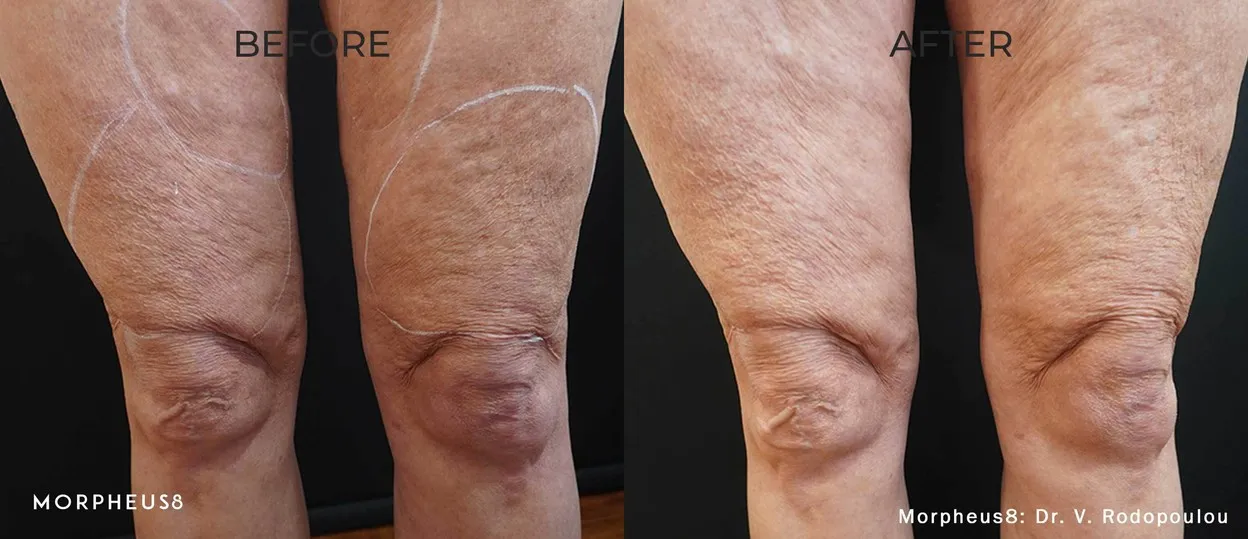
That is a licensed manufacturer image of a real patient’s knees and thighs, credited to the treating physician, and deliberately not the most dramatic pair available to us. Run the checklist and you get a fair reading: a modest, visible change on a real person, with a named doctor willing to stand behind it.
Now the other column. It does not tell you the depth, the energy, the number of sessions, the interval between the frames, or whether anything else was done at the same appointment. No blinded assessor rated it. It is a manufacturer image, which is another way of saying it is the manufacturer’s best foot forward. And it is not our patient, which we will never imply.
What no photograph can tell you
Here is the thing no advert mentions. Morpheus8 is not FDA approved. It is cleared, which sounds similar and is not. Clearance means the paperwork showed the device is similar enough to something already on the market. Nobody at the regulator has found that it works.
And the cleared wording is short. It covers coagulation or contraction of soft tissue, and stopping bleeding, in dermatologic procedures. No Morpheus8 clearance names wrinkles, skin tightening, acne scars, cellulite, stretch marks or fat reduction. Not one of the things those photographs are showing you.
Two more facts belong next to every result photo. On 15 October 2025 the FDA issued a safety communication on radiofrequency microneedling reporting burns, scarring, fat loss, disfigurement, nerve damage and the need for surgical repair, and stating flatly that this is a medical procedure, not a cosmetic treatment. And no sham-controlled randomised trial of Morpheus8 has ever been published. The single independent systematic review that excluded industry-funded studies rates the whole evidence base Level of Evidence 5.
That is not a rating you can argue with using pictures.
So what do you actually do with a before-and-after?
Not ignore it. Photographs are still the closest thing to a preview anybody can offer, and a clinic that shows none at all is not more honest, just quieter. Use them the way you would use a holiday photo of a hotel: real, selectively framed, and no substitute for standing in the room.
Then ask the questions the photo cannot answer. Whether this device suits your skin, your starting point and the stage of ageing you are actually at is not visible in somebody else’s face.
If what is bothering you needs a diagnosis rather than a treatment, a mole that is changing, persistent redness, or a skin condition nobody has properly looked at, see your GP or a dermatologist first. Otherwise, book a consultation with us. You will get an honest assessment of whether this is the right tool for what you want changed, what it can realistically reach, and what we would advise against. What you will not get is a promise built out of somebody else’s photograph.
At a glance
What a before-and-after photograph can and cannot tell you
+ Reasons in favour
- A dated pair that states the area, the session count and the interval between shots is genuinely useful information, and it costs a clinic nothing to provide
- Manufacturer images at least name the treating physician, so somebody's professional reputation is attached to the result on screen
- Photographs are the closest thing to a preview anyone can offer before you commit, and a clinic willing to show modest ones is telling you something about itself
− Reasons for caution
- No marketing photograph is blind scored. In the one Morpheus8 study that compared the two, blinded assessors rated 33 percent of patients markedly improved where the patients rated themselves at 67 percent
- Almost every impressive Morpheus8 result in the published literature involved a second procedure at the same time, so the photograph shows a combination rather than a device
- Lighting, angle, expression and makeup can manufacture a visible difference with no treatment at all, and a finished pair gives you no way to detect it
Frequently asked questions
The short version.
01Why do Morpheus8 before-and-after photos look more dramatic than the studies sound?
Two reasons, and both are ordinary. The first is selection: you are shown the best pairs, never the ones that did not move, and nobody has to tell you how many were taken. The second is that the strongest published Morpheus8 results came from patients treated with something else at the same time, usually FaceTite or BodyTite, so the photograph is showing you a combination and the caption is crediting one device. Add lighting and angle on top of that and the gap between a carousel and a journal is easy to explain.
02Does a manufacturer's before-and-after photo count as evidence?
It counts as documentation, not as evidence. A manufacturer image is a real photograph of a real patient, usually credited to the doctor who did the work, which is more than most social media pairs offer. What it is not is a study. There is no protocol stated, no interval, no blinded assessor, no control, and no way to know how many other patients were photographed and not published. Treat it as the manufacturer's best foot, honestly presented.
03What should I ask a clinic to show me?
Ask for pairs of people whose starting point resembles yours, shot in the same light and at the same angle, with the date of each photograph, the number of sessions, the depth and energy used, and whether anything else was done at the same appointment. Ask what they would consider a poor result and whether they can show you one. A clinic that can answer all of that calmly is a good sign. A clinic that only has spectacular pairs and no numbers is telling you which business it is in.
04Do you publish your own before-and-after photos?
We never generate them. A synthetic result image is a fabricated claim, and no image model will ever be used on this site to invent skin, a face or an outcome. Where a real photograph appears here it is a licensed manufacturer image, labelled as such and credited to the physician who performed the treatment, never presented as one of our own patients. We also do not attach promises to pictures. Anything we say about what a result might look like belongs in a consultation, next to your face, in plain numbers.