
Type “Morpheus8 under eyes” into a search bar and you will find no shortage of clinics happy to book you in. What you will not find, anywhere in the published research, is a study showing it works there. Not a big one, not a small one, not even a sponsor-funded one.
That is not the same as saying it does nothing, and this is not an article that will tell you it does. It is about what the research actually contains, and what you do with that when somebody quotes you a price.
The one big number, and what it counted
The largest thing in the literature touching this area is a retrospective safety review published in 2025 in the Aesthetic Surgery Journal. Its authors went back through their zone-by-zone radiofrequency facial work and counted it up: with Morpheus8, 364 foreheads, 364 periorbital areas, 353 perioral areas and 233 jawlines. Periorbital means the area around the eye. Across all of it, they reported no cases of hyperpigmentation, hypopigmentation, scarring or prolonged erythema.
So yes, there is a real Morpheus8 number here, and 364 is not small.
Here is the catch, and it is really the whole article. That paper is a safety review: it counted things going wrong, and for those four outcomes it counted none. It did not measure whether anybody’s eye area looked different afterwards: no outcome scale for the periorbital zone, no blinded photographic grading, no satisfaction score. It also ran in a journal supplement, the same format that carries most of the flagship Morpheus8 papers, several funded by the manufacturer and written by its consultants.
The honest summary: in one group’s hands, 364 periorbital treatments produced no pigment change, no scarring and no lingering redness that they recorded. That is genuinely reassuring about risk. It tells you nothing about results.
The other study you might get shown
There is a periorbital study that circulates. Fifteen patients, a split-face design, satisfaction reported at over 47 percent. If somebody shows you that one, ask a follow-up question, because it is not a Morpheus8 study.
It appears as a single entry in a list of supporting series inside a review of facial radiofrequency microneedling, gathered from the wider literature rather than reporting on this device, and written by authors with a manufacturer relationship. So the chain runs: a 15-patient study of something else, cited in a sponsor-linked review, arriving on a clinic’s website as eye-area evidence for one machine. It is worth learning to read the evidence a clinic shows you like a sceptic, because the pattern repeats well beyond this area.
So what has anyone actually cleared it for?
Here is the thing no advert mentions. Morpheus8 is not FDA approved. It is “cleared”, which sounds similar and is not. Clearance under the 510(k) route means the paperwork showed the device is substantially equivalent to something already on the market. That is the whole test. Nobody at the regulator concluded it works.
Now read what the clearance actually covers: dermatologic procedures where coagulation or contraction of soft tissue, or stopping bleeding, is needed. That is the lot. No Morpheus8 clearance names wrinkles, skin tightening, acne scars, cellulite, stretch marks or fat reduction, and it certainly does not name the under-eye area.
Two more things belong in the same breath. On 15 October 2025 the FDA issued a safety communication covering radiofrequency microneedling as a class, reporting burns, scarring, fat loss, disfigurement, nerve damage and cases requiring surgical repair, and stating flatly that this is a medical procedure, not a cosmetic treatment. And no sham-controlled randomised trial of Morpheus8 exists. The one independent systematic review that deliberately excluded industry-funded studies rates the whole evidence base Level of Evidence 5, which is the bottom of the scale.
None of that makes the device useless. It does mean nobody has demonstrated anything about the eye area, and a clinic implying otherwise is selling something the research does not contain.

The hardware, which is the most concrete part of this
If there is a technical argument for treating this area, it is the tip. The Morpheus8 Prime tip carries 12 pins and offers depths of 1, 2, 3 and 4 mm. The manufacturer’s manual describes it as being for dermal and subdermal treatment of small areas that are difficult to manoeuvre around, which is a fair description of the orbital rim. Compare the standard tip at 24 pins and 1 to 7 mm, or the body tip at 40 pins and 2 to 7 mm. Energy across the family runs from 5 to 60, except at the 1 mm setting, where it is capped at 30.
That is real engineering aimed at a real problem. It is not evidence of an outcome: a smaller tip means better access, not a proven result. The current generation, marketed as Burst, includes a 12-pin Burst Prime for which no numeric depths are published and no peer-reviewed study exists, so if you are quoted Burst depth figures, ask where they came from.
Then the gap that matters most. The one Morpheus8 paper that publishes its settings zone by zone, a 2025 study of acne and acne scarring, lists the forehead at 1 mm and energy 25 in cycle mode, the cheeks at 2 to 3 mm and 30 to 45 fixed, and the neck at 2 mm and 30 to 40, with everything reduced by roughly 20 percent in Fitzpatrick types V and VI. There is no eye-area row. The depth and energy chosen for the thinnest skin on your face are your practitioner’s own judgement, not a published protocol.
What can go wrong, and where it is written down
The recorded adverse-event rates for Morpheus8 all come from the same place: a 247-patient face and neck cohort, sponsor funded, with the device used alongside another radiofrequency handpiece rather than alone. Prolonged swelling beyond six weeks in 4.8 percent. Hardened areas persisting beyond 12 weeks in 3.2 percent. Neuropraxia, meaning temporary nerve disturbance, in 1.2 percent. None of those are eye-area figures. They are simply the closest thing that exists.
Downtime deserves the wide version, not the flattering one. Published protocols quote 2 to 5 days; the manufacturer’s manual describes oedema and crusting resolving over one to three weeks; the independent review puts visible grid marks at one to two weeks. On a cheek that is inconvenient. Under an eye it is the part of your face people look at while they talk to you. That same review is blunt about where risk really sits: the highest conferred risk of complications was user error. It names post-inflammatory hyperpigmentation among the key risks, and antiviral cover where there is a history of cold sores.
Fat loss is the one that needs care. It sits on the FDA’s list of reported harms and has been documented independently in the neck, where surgeons found contour irregularities corresponding to previous needle penetration. Under the eye there is very little fat, and its position is structural rather than incidental. No case of that happening there appears anywhere in this research, in either direction: nobody has reported one, and nobody has gone looking. Absence of reports is not the same as absence of risk.
If you have had filler under the eyes, raise it before anything else. The manufacturer’s manual treats recent product in the treatment area as a reason to wait, sometimes for months, alongside a long list of other reasons a session gets deferred, which we have gone through in the piece on who can and cannot have this treatment.
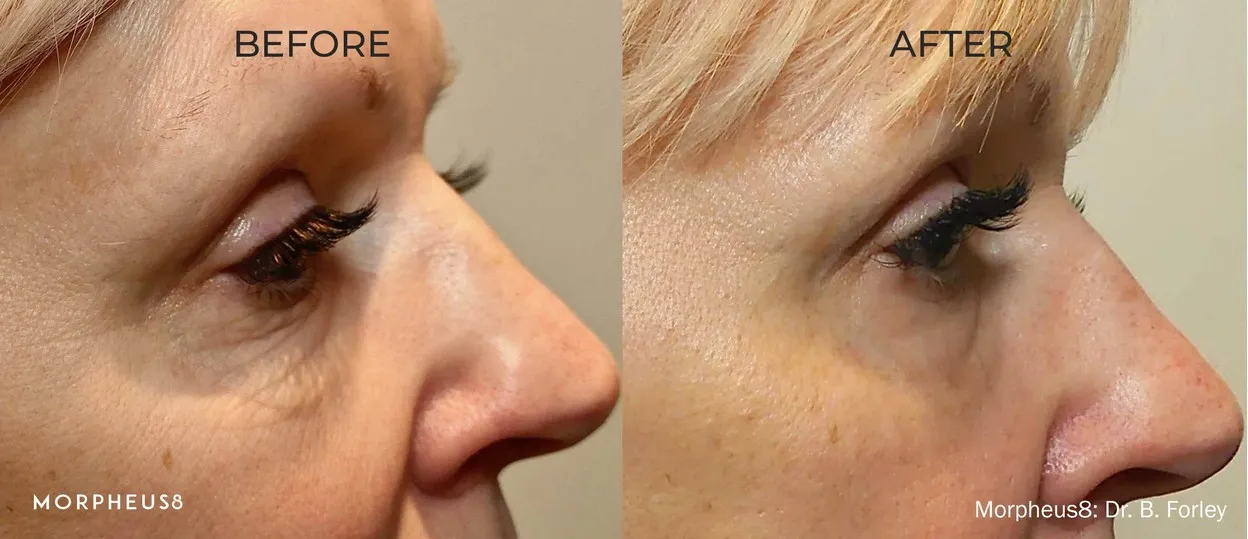
The comparison below is from the manufacturer’s own licensed image library, with the treating physician credited on it. It is not one of our patients, and it is not evidence: a single pair of photographs never is, whoever supplies them.
Questions worth asking when you are being quoted
Start with what is actually being treated. Crepey texture, a hollow, pigment and puffiness are four different problems, and only the first is a skin-quality question. If someone quotes you for the eye area without separating them out, that tells you how the rest of the consultation will go.
Then the mechanical ones. Which tip, and how many pins. What depth in millimetres, what energy level, and how both were adjusted for your skin type. How many sessions, at what spacing, and the plan if nothing changes. Who is holding the handpiece, and how many periorbital treatments they have done. Who you call if swelling or firmness has not settled after six weeks.
And ask the question the research forces: what evidence is this recommendation based on for this specific area. A good answer sounds like “none that is specific, here is my own experience and here is how I keep it conservative.” It is also worth reading what age this treatment is realistically aimed at before deciding the eye area is where to start.
One thing overrides all of it: if what is bothering you is a change in one eyelid, a lump, a lesion, or shadowing that appeared suddenly, see a GP or a dermatologist first. That is a diagnostic question, and no aesthetic clinic is the right first stop.
Where that leaves you
The gap is the story here. Morpheus8 around the eyes has a decent safety count behind it, a tip designed for awkward small areas, and no efficacy evidence at all. Plenty of treatments have less. Very few are marketed this confidently for an area where the published record is this thin, and knowing that puts you in a much stronger position in the consultation room.
If you want an honest read on whether this is the right tool for what is bothering you, book a consultation with us. You will get the depth, the settings, the realistic downtime and the limits of the evidence in plain language, including when the answer is that something else, or nothing, would serve you better.
At a glance
The eye-area evidence, weighed honestly
+ Reasons in favour
- There is a real Morpheus8 number for this area, and it is not small: 364 periorbital zones in one 2025 safety review, with no cases of hyperpigmentation, hypopigmentation, scarring or prolonged erythema reported
- The hardware includes a part built for exactly this problem. The 12-pin Prime tip runs at 1, 2, 3 or 4 mm and is described in the manufacturer's manual as being for small areas that are difficult to manoeuvre around
- Nothing in the published safety data suggests the eye area behaves worse than anywhere else on the face. In the review that counted zones separately, periorbital areas were treated as often as foreheads, 364 of each
− Reasons for caution
- No efficacy study of Morpheus8 on the eye area exists. The 364-zone paper counted adverse events, not results, and carries no outcome scale or satisfaction score for that zone
- The 15-patient split-face periorbital study you may be shown, with satisfaction over 47 percent, is not a Morpheus8 study. It sits in a list of supporting series inside a review written by authors with a manufacturer relationship
- Published settings exist for forehead, cheeks and neck but not for the eye area, so the depth and energy chosen for the thinnest skin on your face is your practitioner's own judgement, and the independent review names user error as the largest source of complications
Frequently asked questions
The short version.
01Is Morpheus8 FDA approved for under the eyes?
No, and twice over. Morpheus8 is 510(k) cleared rather than approved, which means the paperwork showed it is substantially equivalent to a device already on the market, not that a regulator found it works. And the cleared wording covers dermatologic procedures where coagulation or contraction of soft tissue, or stopping bleeding, is needed. It names no cosmetic purpose at all, and it certainly names no body area. Any clinic advertising an approved under-eye treatment is stating something untrue.
02What needle depth is used under the eyes?
There is no published figure. The 12-pin Prime tip, which the manufacturer's manual describes as being for small areas that are difficult to manoeuvre around, offers 1, 2, 3 and 4 mm, and energy across the tip family runs 5 to 60 except at the 1 mm setting, where it is capped at 30. But the one Morpheus8 paper that publishes its settings zone by zone lists the forehead, the cheeks and the neck, and has no eye-area row. Ask your practitioner for their number and their reasoning, and treat a confident answer without a source as exactly that.
03Will it do anything for dark circles?
Nothing in the research addresses dark circles, in either direction. That matters because dark circles are not one thing: they can be pigment in the skin, a shadow cast by a hollow, visible vessels, or a mixture. A hollow is a volume question rather than a skin-quality one. If the shadowing under your eyes changed noticeably or recently, see a GP before you see anybody with a treatment to sell.
04How long would my eyes look treated afterwards?
Longer than the adverts suggest, and the honest range is wide. Published clinical protocols quote 2 to 5 days, while the manufacturer's own manual describes oedema and crusting resolving over one to three weeks, and the independent review literature puts visible grid marks at one to two weeks. In the largest face and neck dataset, swelling persisted beyond six weeks in 4.8 percent of patients. On a cheek that is inconvenient. Under an eye it is the most looked-at part of your face.
05Can I have it if I've had tear trough filler?
Not straight away, and you should raise it before anything else is discussed. The manufacturer's manual treats recent filler in the treatment area as a reason to wait, in some cases for months, until the product has dissipated. It also lists a long set of medical and medication contraindications that apply wherever on the body you are treated. This is one of the things a proper consultation exists to work through, not a detail to mention on the day.